
Breaking the Small Business Burnout Loop: How Hidden HR Inefficiencies Drain Your Profit and Sanity
If you are a small business owner, chances are you started your company to gain personal freedom, build a legacy, and make a meaningful impact. Instead, you might frequently find yourself awake at 3:00 AM, buried under an avalanche of administrative paperwork, wondering how you accidentally became a full-time human resources manager instead of a strategic CEO.
You are far from alone. Traditional business tracking shows that operational bottlenecks heavily compromise founder mental health. When structured internal systems are missing, business owners experience chronic exhaustion driven entirely by systemic decision fatigue.
The core issue is that operational burnout is rarely a personal time-management flaw; it is a fundamental design failure within your organization. There is a direct, invisible line connecting informal, manual people processes to the eventual stagnation of your company’s growth.
Here is how to identify the hidden operational drains in your business and build a scalable infrastructure to reclaim your time.
1. Why Am I So Exhausted? The Reality of Business Owner Role Overload
What is Business Owner Role Overload?
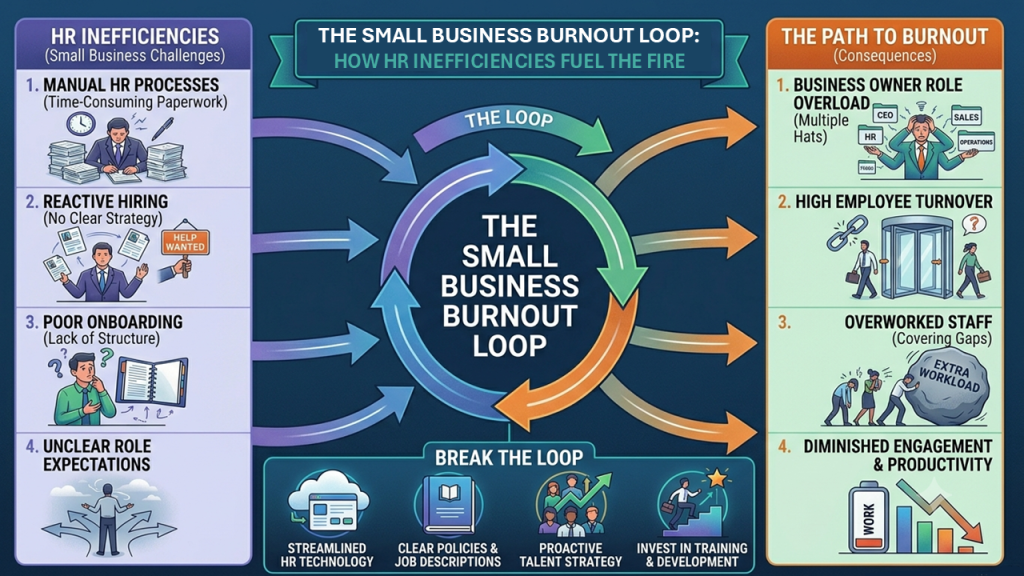
Business owner role overload is an organizational state where an entrepreneur takes on too many competing day-to-day responsibilities, leading to severe decision fatigue and strategic stagnation. When you launch a company, wearing every single hat is a necessity. But as you scale, it becomes a severe operational bottleneck. Role overload traps you when you are forced to simultaneously act as the visionary leader, the head of sales, the customer service safety net, and the primary human resources administrator.
Because people-management tasks are highly reactive, emotionally taxing, and legally sensitive, they pull your focus entirely away from revenue-generating activities.
Why is manual administration fueling the fire?
Manual administrative workflows accelerate operational exhaustion by forcing your brain to spend valuable cognitive energy on repetitive tasks rather than high-level growth. If you are still tracking employee hours on paper timesheets, calculating payroll using mismatched spreadsheets, or printing out physical policy papers, you are wasting precious leadership resources.
Operational tracking shows that unstructured management systems introduce major transcription and compliance risks. Analysis compiled from U.S. Small Business Administration (SBA) tracking data outlines the stark reality of the “Founder’s Trap”—an operational state where a small business’s growth completely stalls because the leader’s time is entirely consumed by manual internal bottlenecks. Official research published by the SBA Office of Advocacy confirms that administrative friction and operational complexity are the primary hidden variables that prevent expanding companies from scaling smoothly. Every manual breakdown results in a compliance or tracking fire you have to personally put out, creating a functional ceiling that traps your sanity.
2. Why Can’t I Retain Staff? The Cost of Reactive Hiring and Poor Onboarding
What causes high employee turnover in small businesses?
High employee turnover in small businesses is primarily caused by unmanaged operational chaos, a lack of structured onboarding, and poorly defined role expectations. Many business owners assume employees leave solely for higher pay. However, empirical workplace data shows a massive decline in overall employee engagement when foundational business structures are missing, leading to widespread losses in team productivity.
In small businesses, the root cause of turnover almost always traces back to the very beginning of the employee lifecycle: Reactive Hiring and Poor Onboarding.
- Reactive Hiring: When you hire out of desperation just to “fill a seat” without a clear talent strategy, it leads to misaligned skills, cultural mismatches, and early departures.
- Poor Onboarding: When a business lacks a structured introduction process, new employees are left to “figure it out” on day one. This creates immediate confusion, frustration, and a fast exit back to the job market.
- Unclear Role Expectations: When job responsibilities constantly shift without warning or documentation, workers become disengaged, feeling as though they have been set up to fail.
When employees quit because of a chaotic environment, you are forced directly back into the reactive hiring loop, stealing more of your time and plunging you deeper into exhaustion.
3. How Do Hidden Inefficiencies Impact Your Existing Team?
The burnout loop does not stop with the business owner. When a company experiences high turnover or lacks structured role definitions, a heavy burden immediately falls on the team members who stay behind.
The Domino Effect on Overworked Staff
The domino effect of unmanaged attrition occurs when the workloads of departing staff members are shifted onto remaining top performers without clear structural boundaries. When an employee leaves due to a poor or chaotic workplace environment, their daily responsibilities do not vanish. Instead, they get piled onto your remaining team.
Your top performers begin covering structural gaps, forcing them to carry an unsustainable extra workload. Over time, their internal resources drain, leading to a severe drop in morale, quiet quitting, or outright resignation. This creates a self-fulfilling prophecy: unmanaged administrative systems create a stressful cycle that actively drives away your best talent.
4. How Do I Break the Small Business Burnout Loop?
Breaking the loop requires moving away from informal chaos and toward a scalable infrastructure. You cannot resolve organizational burnout with personal self-care alone; you must fix the broken systems that are causing the stress in the first place.
Here are the four proven pillars to reclaim your time and protect your business:
Automate manual tasks using technology
Stop using disparate spreadsheets and paper forms. Implement a centralized human resources information system or automated payroll platform to handle time-tracking, benefits administration, and payroll. Modern digital tools handle routine administrative compliance automatically, freeing up dozens of hours of your time each month.
Define clear employee role expectations
Uncertainty breeds workplace anxiety. Document your company policies clearly in a digital employee handbook and ensure every single position has a comprehensive, written job description. When employees know exactly what is expected of them—and how their performance is measured—productivity rises and friction plummets.
Scale retention with a proactive talent strategy
Don’t wait until an employee walks out the door to start recruiting. Build a continuous pipeline of talent and design an intentional onboarding framework. Transitioning from a single-day paperwork routine to a structured acclimation process drastically stabilizes long-term retention, ensuring your hiring investments actually stick.
Safely delegate operations through employee training
Up-skilling your existing staff is significantly more cost-effective than constantly replacing them. When you invest in your team’s professional growth, you build an autonomous middle-management layer. This allows you to safely delegate operations and truly step into your role as a strategic CEO.
The Bottom Line
Informal people management cannot carry formal business risk. When a business feels like it is constantly responding to problems, the underlying issue is often unclear roles, inconsistent processes, weak accountability, or the absence of a proactive workforce strategy.
By improving workflows, defining responsibilities, strengthening performance expectations, and building practical people systems, business owners can reduce avoidable disruption and create a stronger foundation for growth.
Through Sherry Pulcher Consulting, small businesses and blue-collar employers can access practical HR consulting designed to strengthen HR systems, address workforce challenges, improve supervisor effectiveness, and support day-to-day operational performance.
To explore the appropriate next step, schedule a 15-minute consultation at SherryPulcher.com.
Frequently Asked Questions (FAQs) For Entrepreneurs
Question: How much does employee turnover actually cost a small business?
- Answer: On average, organizational analytics demonstrate that losing an employee costs a business significantly more than that employee’s annual baseline salary once you factor in indirect recruitment, operational vacancies, lost momentum, and team retraining cycles.
Question: What is the first administrative task a small business owner should delegate or automate?
- Answer: Payroll and time-tracking. These tasks are highly administrative, strictly regulated, and prone to human error. Automating them via software yields the fastest return on time for a founder.
Question: How long should a standard small business onboarding process last?
- Answer: While many businesses treat onboarding as a one-day paperwork session, a successful, retention-boosting onboarding strategy should ideally span the first 90 days of an employee’s tenure to ensure full alignment and integration.